


Universalis
Universalis Publishing
I found Universalis most useful when I treated it less like a general reading app and more like a dependable daily prayer book that happens to travel well. Developed by Universalis Publishing, this Books & Reference app brings together the Liturgy of the Hours and the Mass for each day, with the important practical advantage of working without an internet connection. That offline approach changes where it fits: it is suitable for a quiet morning at home, a commute with unreliable signal, or a church visit where I would rather not depend on mobile data.
My main interest in reviewing it was not simply whether it contains the right kind of material. I also wanted to see how comfortably a person could find, read, and use that material in different circumstances. A prayer app can be spiritually useful and still become frustrating if its text is hard to follow, its navigation demands too much precision, or its layout assumes perfect eyesight and unlimited attention. Universalis makes a strong case for regular users, although it is not automatically the best choice for everyone.
How the daily reading experience feels
Readability and navigation for regular prayer
The central strength is the way the app gathers the day’s Catholic liturgical content in one place. Instead of moving between a calendar, a missal, and a separate breviary, I can open the app with a particular day in mind and work through the relevant material. That is especially helpful when I am trying to establish a routine rather than merely look up an occasional reading.
The content is dense, so the quality of the experience depends on how comfortable I am with sustained reading on a phone. Someone already familiar with the structure of the Hours will probably feel oriented quickly. A newcomer may need a little time to understand the difference between the various prayer times, the Office readings, and the Mass texts. The app is more useful when I approach it with a basic idea of what I want to pray, rather than expecting it to teach the entire liturgical tradition from the beginning.
I also appreciate the difference between browsing and following a planned prayer period. Browsing encourages me to inspect the day’s material, while a focused session helps prevent the app from becoming another source of digital distraction. My practical tip is to decide before opening it whether I am looking for Mass readings, a particular Hour, or a complete prayer session. That small decision makes the interface feel less crowded because I am not repeatedly backing out of sections without a purpose.
Related News

Why WhatsApp Messenger Still Makes Everyday Communication Feel Easy

Jurassic World: The Game Is the Better Dino Tycoon for Strategic Players

Threads in Real Life: Who Should Join, Lurk, or Leave

How SHEIN Turned Shopping Into an Endless Content Feed

How to Make Fortnite Feel Smarter on Mobile

Should You Switch to Microsoft Outlook on Mobile?
The current version is 2.220, and the app has been available since November 4, 2012. Those details matter less than the overall maturity of the product: this is not presented as a novelty built around a fashionable interface. Its identity is that of a long-running reference tool. The average rating is 4.9 from around 4.5 thousand ratings, which suggests that it has found a committed audience, though a high rating should not be mistaken for a guarantee that every reader will find the presentation effortless.
Useful habits for people who read slowly or revisit passages
For me, the offline design is more than a convenience. It supports a slower rhythm. I can prepare before leaving home, put the phone into a less distracting state, and read without waiting for pages to load or worrying about a weak connection. It also makes the app practical in places where I would not want to hold a conversation with a server or troubleshoot a connection during prayer.
A reader who needs more time with each passage can benefit from treating the app as a reference rather than a timer. I would not rush simply because the text is displayed on a screen. A useful workflow is to open the relevant section before beginning, keep the phone stable, and use the app as the text source while allowing pauses away from the screen. This reduces the visual fatigue that can come from staring continuously at a bright device.
Gallery
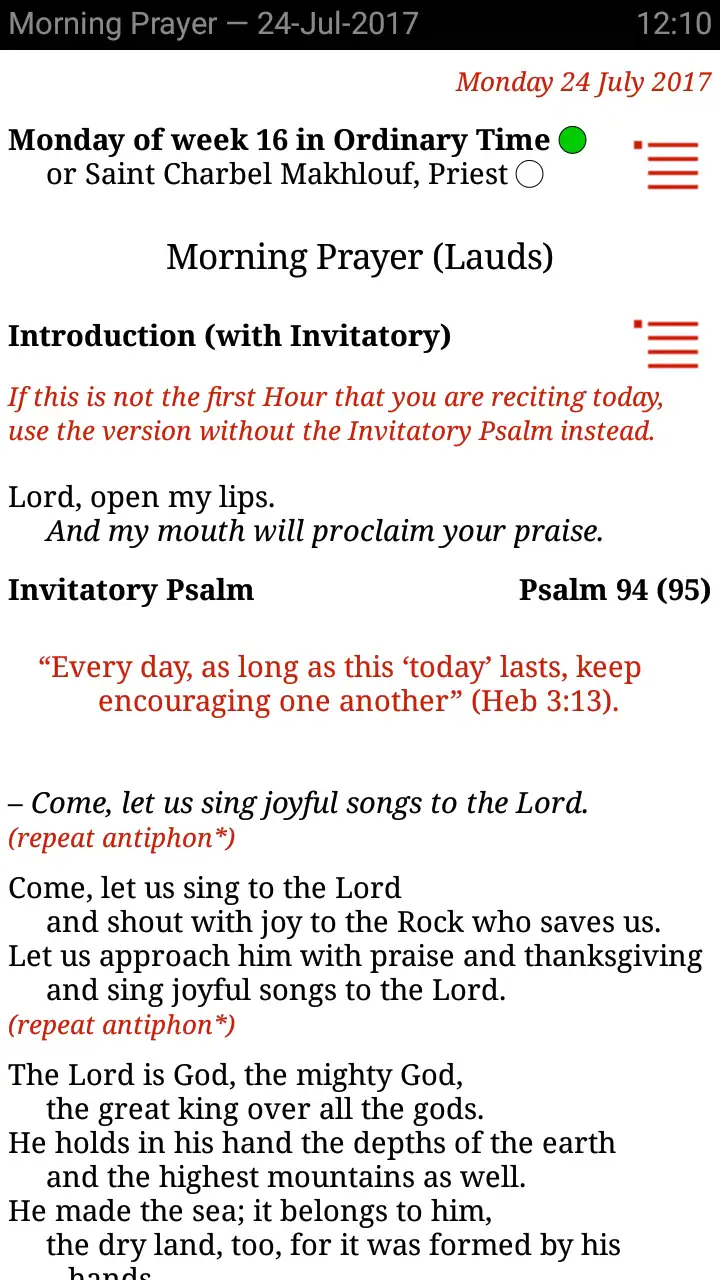
That said, I would not describe the experience as identical to a printed breviary. Paper has a fixed page, a familiar physical orientation, and no battery to consider. A phone offers portability and easier updating of the daily selection, but it also brings notifications, screen glare, and the temptation to switch apps. People who already have a well-organized physical prayer book may find Universalis most valuable as a travel companion or backup rather than a replacement.
How the app supports different visual and reading needs
The most important accessibility question here is not whether the app carries an accessibility label; it is whether the text can be used comfortably by the particular reader. Anyone with reduced vision, light sensitivity, or difficulty sustaining focus should test the reading experience on their own device before committing to it as a primary prayer book. Screen size, system text settings, display contrast, and the person’s preferred reading distance will all affect the result.
I found that a larger phone or tablet is naturally better suited to long liturgical passages than a compact handset. A larger display reduces the amount of scrolling and makes it easier to keep track of where I am. On a smaller screen, the same material can feel more demanding, especially when I am trying to read quietly while standing or moving. This is a meaningful trade-off: the app is portable, but portability can make the text physically smaller and the session less comfortable.
For readers who process information more slowly, the app’s value comes from having the relevant material together rather than from turning prayer into a simplified checklist. The content remains substantial. I would recommend setting aside extra time during the first few uses, learning the order of the sections, and avoiding the assumption that a quick glance is enough to understand the whole layout. Once the structure becomes familiar, the mental effort shifts away from finding the text and back toward reading it.
People who use assistive technologies should check how their own device interacts with the app’s text and controls. I would not promise a particular screen-reader behavior or a specific compatibility level without testing the exact phone, operating system, and settings. The sensible approach is to install it, open a representative daily section, and confirm that navigation, text reading, and movement between sections work with the tools already used in everyday life.
Motor comfort and the realities of phone-based prayer
Motor access can be affected by much more than the number of buttons on screen. A person with limited dexterity may find repeated scrolling tiring, particularly during a longer Office. Holding a phone in one hand while tapping with the other can also be uncomfortable. I get a better experience when the device is supported on a stand, table, or stable surface instead of being held throughout the session.
This is one of the less obvious ways to get more from Universalis: separate the reading setup from the travel setup. On a train or in a waiting room, the phone’s portability is the main advantage. At home, a stable surface and a larger display can make the same content far easier to use. The app itself does not need to change for the experience to improve; the physical arrangement around it does.
Users who have tremors or reduced touch accuracy may want to avoid navigating while walking or standing in a crowded place. A small accidental tap can interrupt concentration even when the app is functioning correctly. My practical recommendation is to open the desired section in advance and minimize unnecessary interaction during the prayer itself. This is not a special feature, but it is a realistic way to reduce motor demands.
People who rely on voice input, switch access, magnification, or other operating-system tools should evaluate the controls in a quiet moment rather than during a service. The app is compatible with devices running Android 5.0 or later, but the operating system requirement alone does not tell me how every accessibility tool will behave. Individual testing remains important, especially for someone who cannot comfortably use standard touch gestures.
Situational access: travel, worship, and interrupted routines
The offline capability is the clearest situational advantage. If I am away from home, underground, in a building with poor reception, or trying to conserve data, the daily texts remain available without an internet connection. That makes Universalis more reliable than a web page that must be loaded at the moment I need it. It also means I can prepare a prayer session before leaving, which is helpful when the destination will be noisy or inconvenient.
One everyday scenario shows the difference well. Imagine leaving for work early, intending to pray before the day becomes busy, but finding that the usual connection is unavailable on the journey. With Universalis, I can open the material beforehand and continue offline. I still need a suitable place and enough attention, but the lack of signal is no longer the obstacle. For someone whose routine includes frequent travel, that may matter more than a decorative interface or social feature.
The same benefit applies to church settings, although using a phone in a sacred space requires judgment. A glowing screen can distract the user and people nearby, and some communities may prefer printed books or a device kept out of sight. I would use the app discreetly, lower distractions as much as possible, and follow local expectations. Offline access helps here because it avoids loading screens, but it does not remove the social responsibility of using a phone respectfully.
It can also serve people whose schedules do not fit a fixed morning or evening routine. Someone working irregular hours may need to pray during a break, while a caregiver may have only short periods of quiet. Having the day’s texts available on demand makes it easier to return after an interruption. I would not expect the app to solve the problem of limited time, but it reduces the preparation needed before a brief session.
Where the experience still creates barriers
The first barrier is cost. Universalis is priced at $12.99, with in-app purchases ranging from $1.99 to $20.99 per item. For a person who is already comfortable with a printed breviary or a free daily-reading resource, paying for a specialized app may feel unnecessary. The price makes more sense for someone who specifically values the complete daily reference and offline use, not for a casual reader who checks one passage every few weeks.
The second barrier is the amount of material. A compact app icon can make the experience look simple, but the underlying content is not lightweight. New users may feel lost if they do not know the names or sequence of the Hours. I would prefer to see the app approached as a tool that rewards gradual familiarity. Start with the section you actually need, learn its pattern, and expand from there. Trying to master everything in one sitting is likely to create needless frustration.
Another limitation is the dependence on a personal screen. People with severe visual fatigue, strong sensitivity to light, or a preference for tactile page navigation may be better served by print. Likewise, anyone who finds phones inherently distracting may pray more attentively with a book. Universalis is not automatically more inclusive merely because it is digital; its benefit depends on whether the user’s device and environment make digital reading comfortable.
There is also a practical device question. The minimum operating-system requirement is Android 5.0, so users with very old phones should check compatibility before planning around it. On supported hardware, the app’s usefulness still depends on battery life, screen condition, available storage, and the physical ability to position the device. Those are ordinary realities of mobile reading, but they become important when the app is intended to replace a book during travel.
Compared with a web-based alternative, Universalis is stronger when connectivity is uncertain and when I want a prepared daily resource. Compared with a printed missal or breviary, it is lighter to carry and easier to keep with the phone I already use, but less tactile and potentially more distracting. Compared with a basic calendar or single-reading app, it is aimed at a fuller liturgical routine rather than a quick inspirational visit. Choosing among these options depends on whether portability, completeness, offline access, or distraction-free reading matters most.
Who will benefit most from it
I would recommend it to Catholics who regularly use the Liturgy of the Hours or want one mobile reference for both the Hours and Mass. It is particularly appealing to travelers, commuters, students, people with changing schedules, and anyone who does not want internet access to determine whether a prayer session is possible. Its strong rating and more than fifty thousand installs indicate a substantial user base, but the more important point is the fit between the tool and the reader’s routine.
It may also help a person who is beginning to build a daily practice, provided that person is willing to learn the structure. The app can reduce the need to gather several books, but it does not remove the need for orientation. I would suggest starting with one consistent prayer period, using the same path through the content for several days, and only then exploring the wider material. That approach makes the app feel like a familiar prayer book instead of a large archive.
I would suggest skipping it, or at least testing it carefully first, if the main goal is an occasional short reading, if paying for a dedicated reference app is not appealing, or if a printed book is much easier on your eyes and hands. It is also not the right choice for someone expecting extensive instruction, community interaction, or a highly simplified devotional experience. Its purpose is focused and text-centered.
An inclusive verdict based on real use
Universalis succeeds because it takes a serious body of liturgical material and makes it available in a portable, offline format. I value that reliability more than novelty. The app can support different contexts well: quiet home use, travel without signal, irregular schedules, and private preparation before attending Mass. With a larger screen, a stable stand, and a deliberate reading routine, it can also be more comfortable for people who find handheld reading difficult.
Still, inclusive use is not automatic. Long passages, touch interaction, screen glare, device compatibility, and the cost can each become a genuine barrier. I would test the app with the accessibility settings and physical setup I actually depend on, rather than assuming that a high rating or a digital format answers those questions. If the text is comfortable, navigation becomes familiar, and offline access matters to me, the purchase is easy to justify.
My final view is favorable but specific: this is a focused Catholic reference app for people who want the daily Hours and Mass material close at hand, not a universal replacement for every prayer book or reading tool. The Everyone age rating makes it broadly suitable from a content perspective, while the real question is whether the user’s eyes, hands, attention, device, and budget fit the experience. For the right reader, Universalis is most valuable when it quietly removes logistical obstacles from a regular prayer routine.
After using it, I would keep it as a practical companion rather than rely on it blindly in every setting. Prepare the day’s material before going offline, support the device instead of gripping it for a long session, begin with one familiar Hour, and compare the screen experience honestly with print. Those small choices reveal its real strength: not replacing tradition, but making a substantial daily resource easier to carry into ordinary life.
FAQs for Universalis
What is Universalis, and what can I use it for?
Universalis is a Catholic prayer and liturgy app that provides daily Mass readings, the Liturgy of the Hours, prayers, and other resources for personal devotion. After installing it, users can follow the day’s liturgy, read Scripture, and pray Morning, Evening, or Night Prayer. It is designed for Catholics who want a portable, organized prayer book available wherever they have a phone or tablet.
Does Universalis require an internet connection to work?
Universalis generally downloads or includes the liturgical content needed for regular use, allowing many prayers and readings to be accessed without a continuous internet connection. This is particularly useful when traveling, attending Mass, or praying in areas with weak reception. However, some updates, additional content, synchronization, or specific online features may require access to the internet, so downloading the app’s latest data before going offline is recommended.
Is Universalis free to download, or does it require payment?
Universalis can typically be downloaded from the relevant app store, but users should check the current listing because pricing and purchase options may vary by platform and region. The app has historically offered a paid version or in-app purchase rather than relying exclusively on advertising. Before downloading, review the store page carefully to confirm the exact cost, whether payment is one-time or recurring, and which features are included.
Which prayers and liturgical resources are included in Universalis?
Universalis is focused on a broad range of Catholic liturgical material. Depending on the edition and date, it may include daily Mass texts, readings, psalms, the Liturgy of the Hours, feast-day information, and commonly used prayers. The app automatically follows the liturgical calendar, which makes it easier to find the correct celebration without searching manually. Content can differ according to language, region, and the app’s current release.
Is Universalis suitable for beginners, and can I change its language or appearance?
Universalis is suitable for both regular users of the Divine Office and people who are beginning to learn how to pray the Liturgy of the Hours. Its organized daily sections make navigation relatively straightforward, although newcomers may need a little time to understand the order of the prayers. Depending on the platform and version, users may also be able to adjust language, text size, display settings, and other reading preferences for more comfortable use.
Pros
- Complete Roman Catholic liturgical calendar with daily readings and prayers.
- Covers multiple languages
- regions
- and liturgical rites for international users.
- Audio readings and chants make it useful for prayer and worship on the go.
- Offline access keeps core liturgical content available without an internet connection.
- Clear navigation makes it easy to find feast days
- readings
- and Mass information.
Cons
- Some advanced features may require an in-app purchase or subscription.
- The extensive content can feel overwhelming for users new to Catholic liturgy.
- Audio availability and quality may vary between languages and readings.
- Calendar details can differ by country
- requiring careful regional configuration.
- Frequent liturgical updates may use noticeable storage and mobile data.


